After the court order: Trump’s tariffs reset, and APAC supply chains are back in the firing line
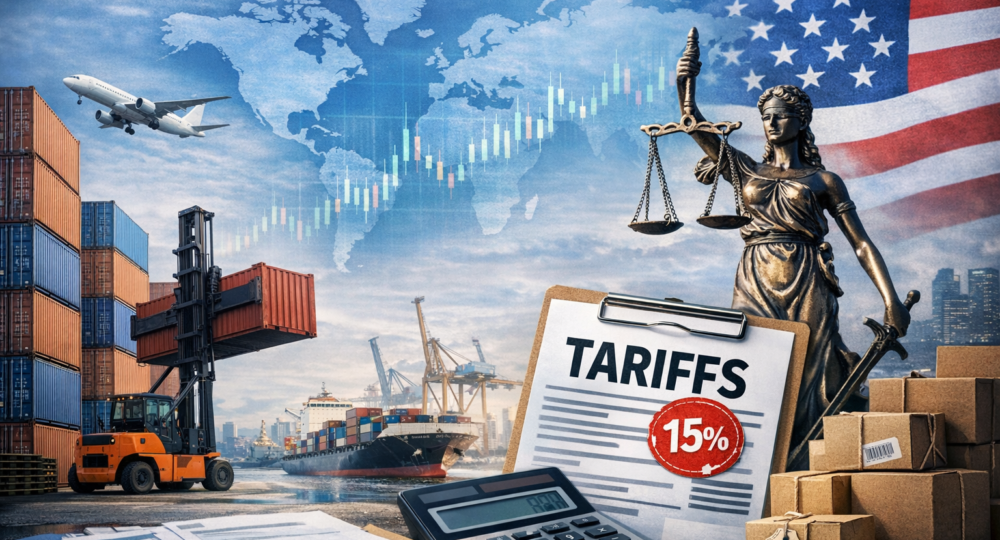
The US tariff regime changed in form, not in intent, after the US Supreme Court ruled on 20 February 2026 that the International Emergency Economic Powers Act (IEEPA) does not authorise tariffs.
For Asia-Pacific exporters, the operational message is blunt. The legal switch has introduced new limits and new timing risks, but it has not removed tariff exposure. The result is a more volatile environment for pricing, fulfilment, and supplier stability.
What the court order actually changed
The court decision struck at a specific feature of the previous system: speed and breadth. Under IEEPA, the tariff programme was widely described as “unbounded” in scope, amount, and duration, because it relied on emergency powers rather than a trade statute built for tariffs.
That mattered because it enabled rapid, wide tariff moves with fewer built-in procedural brakes.
Within hours, the White House issued an order to end the additional ad valorem duties imposed under a list of IEEPA executive orders, which is the practical step US Customs needs before collection stops.
What replaced it, and why it is different in practice
The administration pivoted to Section 122 of the Trade Act of 1974, which explicitly allows a temporary import surcharge but also imposes two constraints that IEEPA did not: a cap of 15% and a maximum duration of 150 days unless Congress extends it.
That is the first key difference for supply chains. The new baseline tariff has a legal “expiry clock”, which increases incentives for shipment front-loading and short-cycle renegotiation.
The second difference is the shape of the tariff itself. Reporting shows the post-ruling policy moved first to a 10% across-the-board duty, then rose to 15% shortly after.
A flat surcharge can reduce extreme country-specific peaks, while still raising costs across the board. That matters for APAC firms that previously faced higher “reciprocal” rates, and for those that were previously at lower rates and are now pulled up.
10% versus 15%: what changed between the two new baselines
The 10% tariff was the immediate “plan B” after the court ruling, but the rapid move to 15% is a material shift because 15% is the maximum Section 122 rate discussed in the White House’s own explanation of the statute.
In practical terms, 10% is often absorbed through a mix of discounts, freight optimisation, and margin. At 15%, many importers start to reopen contracts, adjust product mix, and lean harder on origin and classification strategies, because the numbers get too large to treat as temporary noise.
One useful way to see the difference is the effective tariff rate picture. The Budget Lab at Yale reported that the overall average effective tariff rate was about 16% before the IEEPA tariffs were struck down, dropped to 9.1% immediately after the ruling, then rose to around 13.7% after the Section 122 tariffs were imposed.
That is not a perfect proxy for every sector, but it captures the headline. The court ruling briefly lowered the burden, then the replacement surcharge pushed it back up.
How APAC governments reacted: cautious, critical, and looking for room to manoeuvre
In Japan, the immediate response from government was to examine the ruling and the US response and “respond appropriately”, while a senior ruling-party figure publicly called the new tariffs “outrageous”.
This mix is typical of an ally facing trade risk: avoid escalation in official channels, but signal domestic political unease.
In China, the Ministry of Commerce said China was making a “full assessment” of the Supreme Court ruling and urged Washington to lift “relevant unilateral tariff measures” on its trading partners. That choice of language is telling for supply chains. It is not framed as “China only”. It frames the tariff issue as a broader unilateral-measures problem, which is consistent with China positioning itself as speaking for wider trading partner interests. In Hong Kong, China, the finance chief framed the episode as a “fiasco” that reinforces the value of predictability and Hong Kong’s separate customs territory position, which officials see as a resilience advantage in tariff turbulence. In Taiwan, China, the cabinet said it was monitoring closely, and it flagged uncertainty about how the US would implement trade deals it has reached with partners. For a tech-heavy exporter, the fear is less the one-off surcharge and more what follows, such as deeper probes under Section 301.
In Thailand, an official at the Trade Policy and Strategy Office suggested the ruling could even trigger a new wave of front-loading, as shippers race goods into the US before further tariff moves.
Front-loading can lift near-term export numbers, but it can also create later demand troughs and production instability, which is where labour and overtime risks often show up.
India reportedly delayed a planned US trade delegation visit after the ruling, which signals tactical caution while the tariff baseline resets.
Beyond these examples, Reuters also noted that South Korea signalled it would continue cooperating, even as it watches for further retaliation risk through other trade tools.
That is a reminder that the court ruling changes legal plumbing, but partners still treat the US as willing to use other levers.
Why this is now a responsible supply chain issue, not only a trade compliance issue
Tariff shocks often get pushed down the chain in ways that create predictable social and governance risks. When buyers face sudden cost increases, they may shorten lead times, demand price cuts, or reduce order certainty. Those choices can trigger excessive overtime, wage pressure, unauthorised subcontracting, and weaker grievance access at the factory level. The volatility itself becomes a human rights risk factor.
The court decision reduced one source of “instant tariffs”, but the administration has already signalled it will use other authorities and investigations to keep pressure on partners.
So the resilience question for APAC suppliers is not only “what is today’s rate”. It is whether firms can absorb tariff moves without creating labour harm, compliance errors, or supplier failure.
What supply chain leaders in APAC should take from this reset
You can treat the post-ruling system as a new cycle with three features: it has a legal time limit, it has a rate ceiling, and it can still be followed by more durable actions through other US trade laws.
Companies that cope best tend to do three things. They make tariff responsibility explicit in contracts and pricing terms, so disputes do not explode mid-shipment. They tighten origin, classification, and valuation controls, because errors now carry bigger cash consequences. They build “surge discipline” with suppliers, so front-loading and rush orders do not translate into labour abuse.
That is what tariff agility looks like in 2026. The court order narrowed one path. The commercial pressure remains.
This article is also available in:

Leave a reply