Responsible supply chain is no longer a nice-to-have. It is becoming a compliance requirement. The EU’s Corporate Sustainability Due Diligence Directive (CSDDD) and the US Uyghur Forced Labour Prevention Act (UFLPA) have pushed many suppliers and brands across APAC to prove their supply chains are free of forced labour.
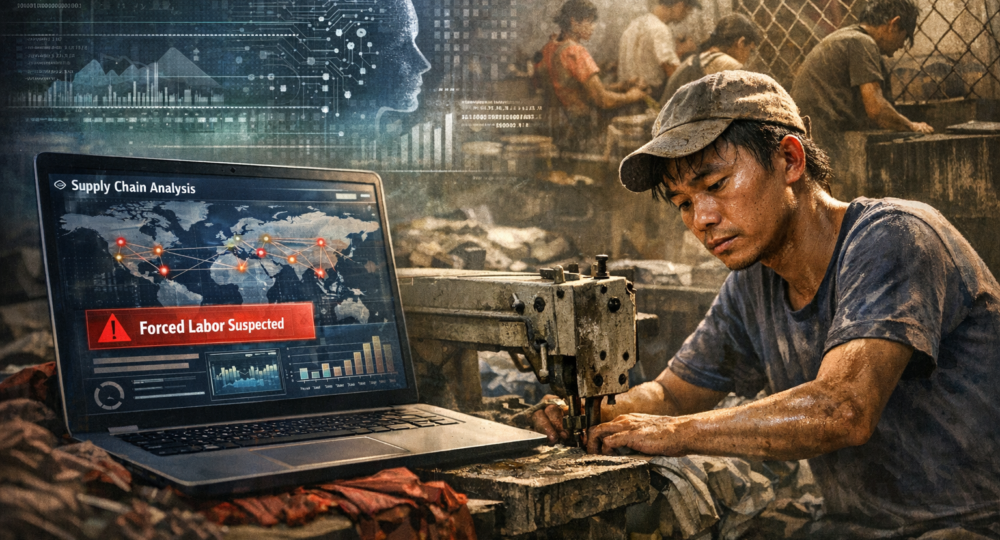
In that pressure cooker, Artificial Intelligence has been sold as the answer.
Platforms now promise to scan vast supplier networks in minutes and flag forced labour risk before it surfaces. For compliance teams stuck in endless spreadsheets, it sounds like relief. Yet one question refuses to go away. Can a machine detect the messy, hidden reality of modern slavery?
The promise: speed and scale
AI is extremely good at processing large volumes of data. If you sit in Singapore and oversee suppliers across Vietnam, Bangladesh, and Indonesia, the flow of information can overwhelm any team.
Today’s tools tend to perform best in two areas.
They can help map supply chains. They can pull in bill-of-lading data, company registries, and trade records to reveal Tier 2 and Tier 3 entities that a brand did not know existed.
They can help scan public signals. “Social listening” tools sift local news, social media, and NGO reports across multiple languages, then flag strikes, allegations, or negative coverage at speed.
If the aim is to organise information, AI can be a real upgrade. If the aim is to detect human rights abuse, the picture becomes less comfortable.
The reality: forced labour leaves little trace
AI depends on patterns in data. Forced labour often exists where data is absent or distorted.
1) The “clean data” fallacy
Some of the worst risks in APAC sit in informal work, unlicensed subcontracting, or labour brokers who operate off the books. These actors do not publish reports. They do not show up in polished datasets. They may not appear in trade records in a way that reveals labour conditions.
If a factory confiscates migrant workers’ passports, that coercion can produce no public footprint. A model that reads trade flows and corporate filings may see a stable site. It may miss the abuse because the abuse never becomes data.
2) The context gap
Labour risk is not a simple keyword problem. AI often struggles with nuance.
A tool might flag “labour unrest” in India as a risk marker. A human specialist might read the same signal as evidence that workers can organise, speak up, and bargain. On the other hand, silence in the media can mean intimidation, censorship, or fear.
False positives also create a practical burden. Many teams now face an avalanche of alerts triggered by vague terms. People then spend time dismissing noise, not checking genuine harm.
3) The “black box” legal risk
New due diligence laws create a need to explain decisions. Under regimes such as Germany’s Supply Chain Act (LkSG), a company may need to show how it assessed risk and why it acted.
If you end a supplier relationship because “the algorithm flagged it”, you may struggle to justify that step. If you keep a supplier because the system scored it “low risk”, and severe abuse later emerges, “the model said it was fine” is not a defence.
The irony: AI has a supply chain too
There is another awkward layer. Many AI systems rely on “ghost work” such as data labelling and content moderation. This work is often outsourced to lower-paid workers in the Global South. Conditions can be precarious. That makes the sales pitch uncomfortable: tools marketed as ethical enforcement can sit on labour models with their own welfare questions.
A better path: augmented intelligence
AI can help, but it should not sit in the pilot’s seat. It works best as a co-pilot.
A hybrid approach tends to deliver stronger outcomes.
AI can support triage. It can handle supplier mapping, cluster risks by sector and geography, and point teams towards potential hotspots.
Humans must handle verification. Off-site worker interviews, unannounced visits, and trusted local partners remain the ways to detect debt bondage, sexual harassment, intimidation, and psychological coercion. Those realities rarely show up in dashboards.
Technology can improve traceability. It cannot replace responsibility.
You can automate paperwork. You cannot automate trust.