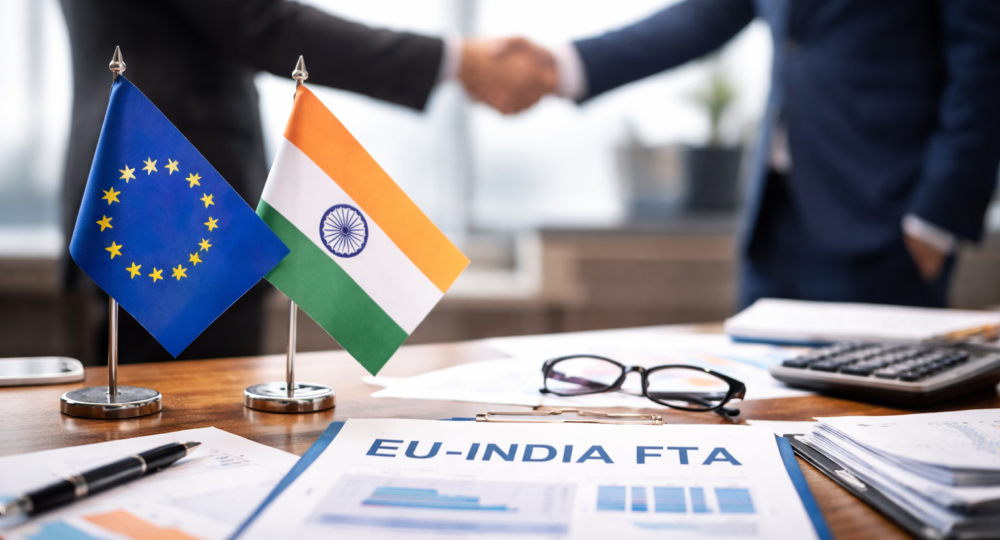
After years of stop-start talks, the European Union and India have announced that negotiations on an EU–India Free Trade Agreement have been concluded. The European Commission has presented it as a major strategic and economic step, and it has pointed to the final formal negotiating round taking place in October 2025, followed by technical and political work that carried the process into early 2026.
What happened, in sequence
Negotiations were restarted in 2022 after a long pause, and successive rounds ran through 2025.
The Commission’s public account is that the last formal round was held in October 2025, then the sides continued work between rounds before announcing the conclusion in January 2026.
On the Indian side, the Ministry of External Affairs (India) also briefed that leaders announced the successful conclusion during the late-January 2026 EU leadership visit.
A joint statement framed the trade outcome alongside broader cooperation on areas such as technology, which suggests the political package goes beyond tariffs alone.
What is known about the deal so far
Most detailed information in the public domain is still high level. That said, several points have been widely reported.
Reuters reported that the agreement would eliminate or reduce tariffs across 96.6% of traded goods by value, and that the EU expects this to materially lift EU exports to India over time, with an EU estimate of around €4 billion in duties savings for EU companies.
Reuters also reported that the package includes sector-specific market access elements and quota arrangements, with particular sensitivity around areas such as autos, spirits, textiles, and steel.
Separately, think-tank commentary has argued that geopolitics played a major role in getting the agreement over the line, not only classic bargaining over tariffs and services access.
What it could change for Asia-Pacific markets
Even before entry into force, “concluded negotiations” shifts expectations. Pricing models, sourcing plans, and investment pipelines start to move because firms anticipate future landed-cost advantages and new market access.
Stronger competitive pressure in price-sensitive exports
If the tariff reductions and coverage described in public reporting translate into implementation, India’s export competitiveness into the EU could improve in product categories where tariffs still matter to buying decisions. That can create knock-on effects across Asia-Pacific. Competing suppliers may need to defend market share through reliability, speed, quality, and credible compliance evidence, not only price.
More EU-linked investment interest in India
Trade deals often unlock a second-order effect: EU companies become more willing to place production, sourcing offices, or long-term supplier development in the partner market, because the rules of access feel more predictable. If this happens at scale, it can reshape procurement strategies for sectors such as machinery, automotive components, and higher-value manufacturing.
Compliance expectations will not ease, even if tariffs fall
Tariff relief does not remove the broader shift in EU expectations on supply chain risk, evidence, and disclosure. Many EU buyers are already building structured supplier requests around due diligence and sustainability reporting cycles. That means suppliers may face tighter documentation demands as trade volumes grow, not fewer.
Why the negotiated text is still not public, and what to make of the confidentiality talk
At the time of writing, the full negotiated text has not been published. That is not unusual immediately after a political announcement. Trade agreements typically go through legal scrubbing, annex finalisation, and translations before release.
The Commission has publicly set out next steps, and it places publication of negotiated draft texts at the top of the list, ahead of legal revision and translations. Reuters also reported that draft texts are expected to be published as the process moves into legal and political approval stages.
At the same time, there is talk in policy and market circles that the Indian government may prefer a slower or more controlled public release of the negotiated text, and that the Commission may be willing to accommodate that. There is no on-record confirmation of this claim in the official EU or Indian readouts cited above. Until there is a named statement or a formal decision published by either side, it should be treated as unverified.
For businesses, the practical point is straightforward. Use current signals for scenario planning, but avoid irreversible decisions based on leaked summaries or second-hand claims. The reliable moment is when negotiated draft text, or an official chapter-by-chapter summary, is available for checking against what customers and advisers are saying.
What companies should do now
Start with commercial exposure. Identify which product lines might see the largest tariff shifts, and model the effect on landed cost and competitiveness.
Prepare for buyer questions that follow trade expansion. If EU customers scale orders, supplier onboarding often becomes more formal, with clearer expectations on evidence packs, traceability, and corrective action.
Track official releases closely. The Commission’s own stated next steps on publishing draft texts and moving through legal revision will be the clearest signals for when “headline” becomes “operational”.