From China+1 to Vietnam+1 — and now what comes next for APAC supply chains?
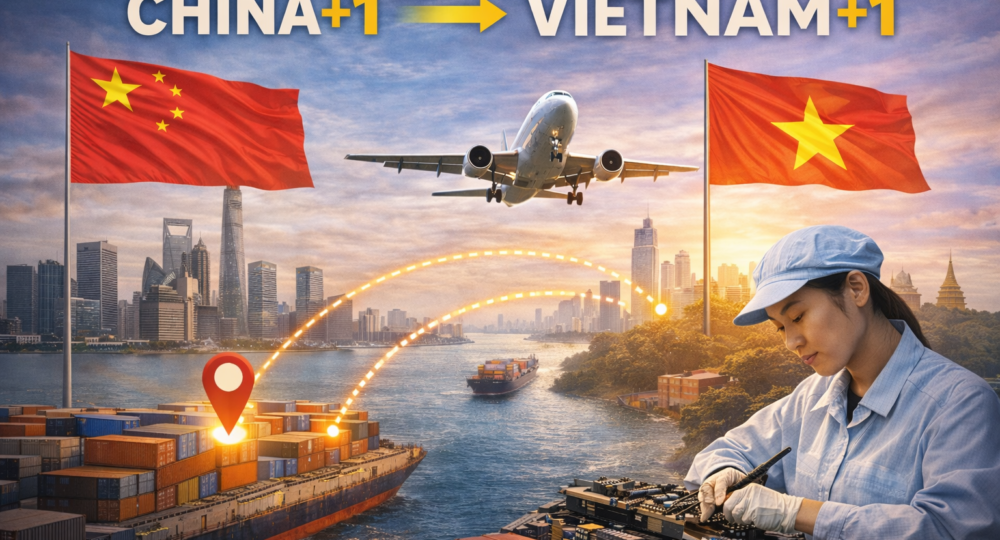
The old debate asked one question: “Which country is the next China?”
That is no longer the right question.
A more useful question for 2026 is this: how do companies build a portfolio of production locations without creating a new concentration risk, a governance gap, or a cost structure they cannot manage?
Vietnam remains one of the strongest beneficiaries of diversification. Its 2024 GDP growth reached 7.09%, exports rose 14.3% to US$405.53 billion, and realised foreign investment inflows increased 9.4% to US$25.35 billion, according to Reuters reporting of official data. At the same time, the same Vietnam story now comes with harder operational questions: power reliability, labour costs, and rising tariff exposure linked to trade policy volatility. Reuters has reported both prior power-related disruption risks and new tariff anxiety among manufacturers operating in Vietnam.
That is why “Vietnam+1” is not a replacement strategy. It is the start of a more complex era.
The real shift is from relocation to portfolio design
For many boards, “China+1” was first framed as a hedge. In practice, it became a partial reallocation, often to Vietnam, while core operations stayed in China because of supplier density, engineering capabilities, and speed.
Now, a second shift is underway. Companies are no longer only asking where to move assembly. They are splitting decisions across layers.
They may keep supplier ecosystems and high-value inputs in China, scale assembly in Vietnam, add back-end or testing capacity in Malaysia or Thailand, build component depth in India, and develop market-facing production in Mexico or other nearshore locations.
This is less neat than the earlier narrative, but it is closer to operational reality.
Why Vietnam is still attractive — and why companies are hedging Vietnam too
Vietnam is still a serious manufacturing platform, especially for electronics, garments, footwear, and export-oriented production. It has scale, policy focus, and a track record of attracting large multinationals. Reuters notes that more than 60% of Vietnam’s US$500 billion foreign investment stock is in manufacturing (government data, updated to end-January in the cited report).
But several pressure points are now harder to ignore.
Vietnam’s minimum wage was set to rise by more than 7% from 1 January 2026, which affects labour cost calculations, especially in labour-intensive sectors.
Power security remains a board-level issue after earlier shortages. Reuters reported that previous shortages contributed to output losses and that Vietnam has since moved to expand power capacity under an amended national plan requiring very large investment by 2030.
Trade policy risk has also moved up the list. Reuters reported in February 2025 that many U.S. manufacturers in Vietnam feared layoffs and supply-chain disruption if tariff measures were expanded, with high concern levels among surveyed manufacturers.
This does not make Vietnam a poor choice. It means Vietnam is no longer a low-friction answer.
The alternatives are real — but each solves a different problem
There is no single “winner” because countries compete on different parts of the value chain.
Thailand is pushing hard to deepen its electronics and semiconductor role. Reuters reported in January 2026 that Thailand aims to attract US$79 billion of semiconductor and electronics investment by 2050 under a new long-range ambition. Thailand also recorded a strong rise in investment applications in 2024, including foreign investment into electronics and digital sectors, according to Reuters reporting of BOI figures. That makes Thailand a credible platform for firms seeking a more mature industrial base in mainland Southeast Asia, though costs and politics remain part of the decision.
Malaysia remains highly relevant in semiconductor value chains, especially for assembly, testing and packaging. MIDA states that Malaysia is the sixth-largest semiconductor exporter and holds 13% of the global semiconductor packaging, assembly and testing market. MIDA also reported RM285.2 billion in approved investments in the first nine months of 2025, with manufacturing accounting for RM93.8 billion. For companies that need capability depth rather than only cheap labour, Malaysia often looks stronger than headline “China+1” discussions suggest.
India offers scale, policy support, and a large domestic market, but execution remains uneven across states and sub-sectors. India’s official communications note a ₹76,000 crore outlay for the India Semiconductor Mission and reported total approved projects reaching 10 with cumulative investments of around ₹1.60 lakh crore. The Electronics Components Manufacturing Scheme (ECMS) was notified in April 2025 with an original outlay of ₹22,919 crore, and the Indian government later proposed increasing the outlay to ₹40,000 crore in the 2026-27 budget announcement. India is building momentum, but firms still need realistic timelines on infrastructure, approvals, supplier readiness and logistics integration.
Mexico and wider Latin America still matter, especially for North America-facing supply chains. Mexico recorded a first-quarter 2025 FDI inflow of US$21.373 billion, described as a record for that period by a platform citing Mexico’s Ministry of Economy data. But nearshoring is not a one-way rise. Reuters also reported factory job losses and tariff-related stress in Ciudad Juárez in 2025, showing how quickly trade policy shocks and local cost pressures can hit a supposedly “safe” nearshore model.
The lesson is simple. “Alternative country” selection cannot be done on wage tables alone.
What many companies still miss: resilience is not the same as dispersion
A common mistake is to treat diversification as a map exercise.
Adding more countries can reduce geopolitical concentration risk. It can also create new failure points in supplier visibility, customs compliance, labour standards oversight, and quality management.
A supply chain spread across Vietnam, Thailand, Malaysia, India and Mexico may look safer on a PowerPoint slide. In practice, it can become more fragile if the company has not built the management system to run it.
This is where responsible supply chain thinking becomes commercial, not cosmetic.
Companies need to ask, before expansion:
Can we maintain the same labour standards and grievance channels across all sites and tiers?
Can we verify environmental and emissions data consistently, not only collect declarations?
Do we understand energy reliability and water stress at site level, not just national averages?
Do we have a clear tariff and customs playbook if rules change mid-quarter?
Can our procurement teams handle multi-country supplier development, or are they still optimised for single-country sourcing?
These are not “ESG add-ons”. They affect continuity, cost, legal exposure and delivery performance.
The China question has not disappeared
It is also a mistake to read “China+1” as “China exit”.
For many sectors, especially electronics and complex manufacturing, China remains difficult to replicate quickly because of supplier networks, skilled labour, tooling ecosystems and speed of iteration. That is why many firms are building parallel capacity elsewhere while keeping major operations in China for either domestic market demand, component sourcing, or both.
The strategy that is emerging is not subtraction. It is selective duplication.
That is more expensive in the short term. It is often more resilient in the medium term.
What “now what?” looks like in practice
The next phase is likely to be “networked manufacturing”, not a new single champion.
That means firms will increasingly build:
A China base for ecosystem depth and market access.
A Southeast Asia cluster (often Vietnam plus Thailand or Malaysia) for export diversification.
An India option for long-term scale and domestic demand.
A nearshore node (such as Mexico) for regional responsiveness, where the trade policy case still works.
A tighter governance layer across all of the above, covering labour, environmental performance, supplier due diligence, and trade compliance.
This is harder than the earlier China+1 playbook. It also reflects the world more honestly.
The companies that do well in this cycle will not be the ones that move fastest to the next low-cost country. They will be the ones that build supply-chain architecture that can absorb shocks, meet regulatory scrutiny, and still deliver on time.
That is the real shift after Vietnam+1.
This article is also available in:


Leave a reply