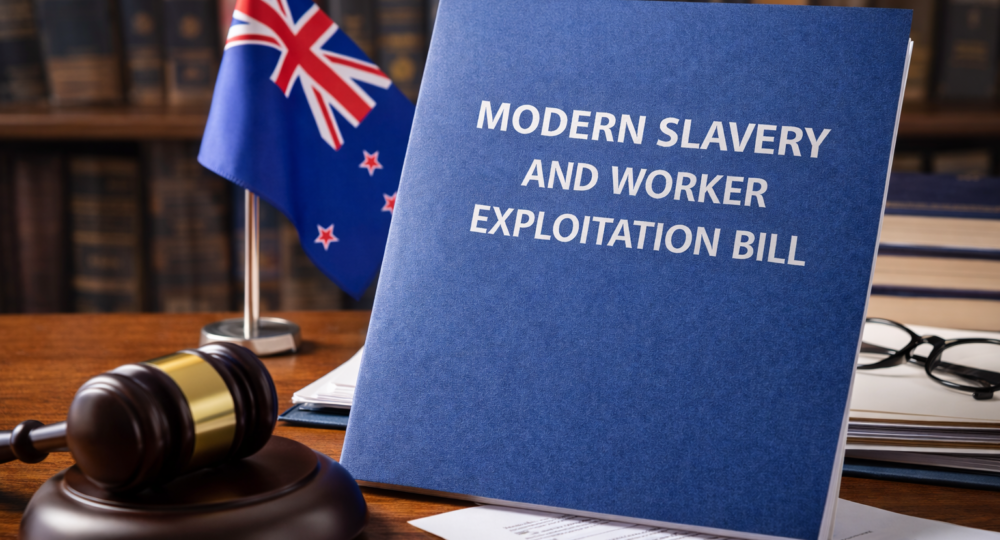
New Zealand is moving towards a modern slavery reporting regime through a proposed Modern Slavery and Worker Exploitation Bill, lodged with rare cross-party backing and expected to receive its first reading in Parliament in February 2026.
The Bill is best understood as a business-facing accountability and transparency framework, rather than a new set of criminal offences. It aims to push large entities to find and address modern slavery risks in their operations and supply chains, then report what they have done in a structured way, on a public register.
Why this Bill, and why now
The Bill sits on top of several years of policy work and consultation. New Zealand agencies consulted in 2022 on options that would create graduated responsibilities across organisations, with stronger obligations for larger ones, and a clear emphasis on risks that arise both domestically and overseas through supply chains.
Policy documents from MBIE set out the core diagnosis: voluntary action has not been enough, and New Zealand has been under pressure to align with key trading partners that already use modern slavery supply-chain laws.
Who would be in scope
Public reporting on the proposed Bill consistently points to a NZ$100 million consolidated annual revenue threshold for reporting entities, and it is described as applying to large New Zealand entities and to overseas companies carrying on business in New Zealand once the threshold is met.
In practical terms, this design means the largest “demand drivers” will often be brand owners, major retailers, large manufacturers, and big service providers. Their suppliers will feel the effect through contract terms, data requests, and remediation expectations, even if those suppliers are not directly in scope.
What “modern slavery” and “worker exploitation” cover
New Zealand policy material uses “modern slavery” as an umbrella for severe exploitation a person cannot leave due to threats, coercion, violence, deception, or abuse of power. It typically includes forced labour, debt bondage, forced marriage, slavery, and human trafficking.
The current Bill commentary in the market also suggests the Bill’s definition of “modern slavery” is anchored to recognised offences and international concepts, including trafficking in persons, the worst forms of child labour, and related forced labour and servitude concepts.
The “worker exploitation” part matters because New Zealand has long had domestic exploitation cases that do not always meet the threshold of “modern slavery” under criminal law, but still involve serious breaches of employment standards. Earlier government consultation framed worker exploitation in this way.
Because the Bill text has not been cited in full through an official parliamentary link in the sources above, it is sensible to treat exact drafting points as subject to change until the introduced Bill is published in full.
What the Bill would require large entities to do
Across multiple professional summaries, the centrepiece is an annual modern slavery statement that must be prepared and published, with set content expectations.
A typical description of the required statement content includes: the entity’s structure, operations, and supply chains; the modern slavery incidents, and known or anticipated risks; what actions were taken to assess, prevent, address, mitigate, and remediate those risks; how complaints were handled; and how the entity measures effectiveness and improves its approach over time.
The Bill is also described as requiring entities to lodge statements on a public register, overseen by a Registrar, with the Registrar also producing an annual report that collates information from lodged statements.
Several summaries indicate a reporting timetable tied to the end of the reporting period, including expectations that statements be published within months of year-end.
Governance and enforcement tools that matter in practice
Two enforcement levers tend to drive behaviour change in these regimes: “public visibility” and “penalties”.
Media reporting in New Zealand has referenced civil penalties, a public register, and a formal role for the Human Rights Commission, with discussion of potential future review steps such as an anti-slavery commissioner.
Professional commentary also points to penalties and enforcement consequences, and it urges businesses to engage early because design choices on enforcement, liability, and remedies can change during the select committee process.
How it fits with New Zealand’s existing legal framework
New Zealand already has criminal offences related to slavery and trafficking under the Crimes Act framework, and Parliament has recently considered higher penalties for slavery-related offences through separate legislation.
The modern slavery Bill is different in purpose. It aims to create ongoing organisational responsibility for risk identification and response in supply chains, rather than focusing only on prosecution after harm occurs. This distinction is also central to public debate, with critics arguing it is “reporting” rather than “real enforcement”, while supporters argue it lifts expectations across the market.
Likely timeline, and why the details may still shift
Current reporting points to first reading in February 2026 and then the usual select committee phase.
Some legal commentary suggests that, even if the Bill moves quickly, the operational start may be later, with initial obligations falling in a later reporting year.
This matters for businesses because the regime’s most important features (scope, penalties, statement content, assurance expectations, and any due diligence “teeth”) often change during parliamentary scrutiny.
What it means for Asia-based suppliers and service providers
Even if your organisation is not directly in scope, the Bill is likely to tighten expectations for suppliers serving large New Zealand buyers.
You can expect more structured supplier questionnaires and contract clauses, particularly on recruitment fees, labour brokers, migrant worker risks, subcontracting controls, grievance channels, and remediation evidence.
You can also expect more emphasis on traceability and “proof of process”, because a public statement forces buyers to show not only policies but also how they assess effectiveness and respond to incidents.
For service providers in Asia (auditors, social compliance firms, legal advisers, data platforms), this can increase demand for risk screening, grievance systems, and credible corrective action tracking, especially if New Zealand buyers want to standardise evidence across multiple regulatory regimes.
The main open questions to watch
The first is whether the Bill remains primarily a transparency regime, or whether Parliament adds stronger due diligence duties. Civil society groups have already criticised transparency-only models for being too weak, citing lessons from other jurisdictions.
The second is how “worker exploitation” is treated relative to “modern slavery”, because that choice affects the number of incidents that must be tracked and remediated, and it can affect how suppliers are assessed.
The third is how enforcement is designed in practice, including the size and triggers for penalties, the role of the Human Rights Commission, and whether there are consequences for poor-quality statements, not only missing ones.





[…] New Zealand’s Modern Slavery and Worker Exploitation Bill: what it is, how it may work, and what i… […]