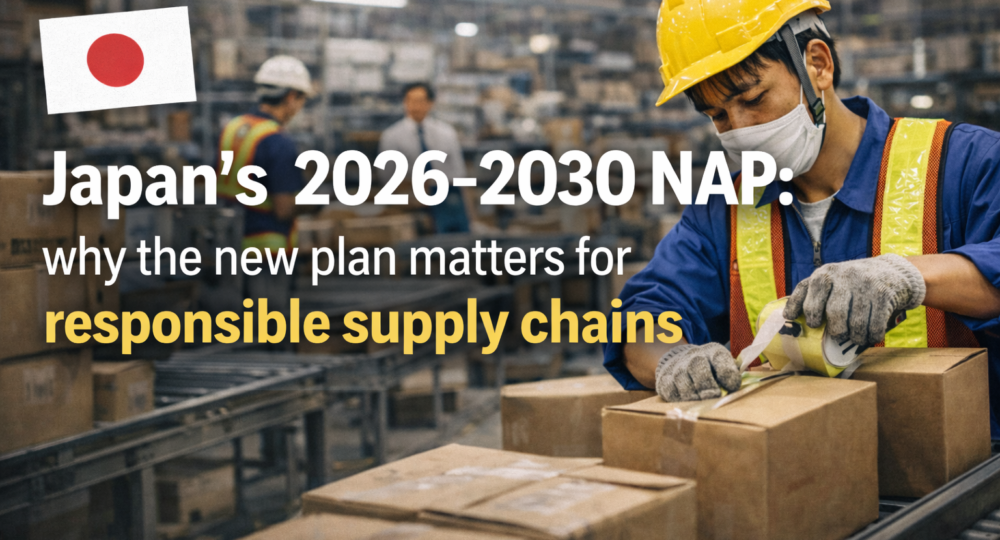
Japan closed its first National Action Plan (NAP) on Business and Human Rights (2020–2025) with a clear message: the “business and human rights” agenda will no longer sit on the edge of compliance. In December 2025, the government approved a revised NAP that starts from fiscal year 2026, with a formal review planned within five years.
That five-year cycle is why many stakeholders refer to the revised plan as the “2026–2030” NAP in practice, even though the document frames the start date and review horizon rather than placing “2030” in the title.
What makes the 2026–2030 NAP different
Japan’s revised NAP is structured around eight priority areas, which is more than a re-labelling exercise. It pulls together topics that used to sit in separate policy lanes and puts them under one cross-ministry agenda.
The eight priority areas are as follows.
Human rights due diligence and supply chains sits as the first pillar, signalling that “responsible supply chain” work is no longer seen as optional guidance for exporters only.
A “leave no one behind” strand groups policies for groups that face heightened risk, including gender equality, foreign workers, children and young people, persons with disabilities, and older persons.
Two thematic issue areas, AI and technology, and environment and human rights, bring newer risk areas into the same framework as labour and discrimination concerns.
Capacity building for implementation of the UN Guiding Principles places practical support and training—especially for smaller firms—into the NAP itself, rather than leaving it to ad hoc programmes.
Corporate disclosure is treated as a policy area, with an explicit intention to track international standards and push better quality reporting on human rights respect.
Public procurement and public contracts (including subsidies) is elevated as a lever. The summary points to stronger use of procurement requirements, and even the possibility of integrating human rights respect into subsidy-related criteria where feasible.
Access to remedy is framed as a package, including strengthening engagement around Japan’s National Contact Point (NCP) and encouraging company-level grievance mechanisms aligned with the UN Guiding Principles.
Implementation and monitoring is given its own priority area, with annual review of progress and a stated intention to rely on objective indicators where possible, plus ongoing stakeholder dialogue.
This combination matters because it treats forced labour risk as part of an ecosystem. It links what happens in a supplier dormitory, a recruitment corridor, a logistics warehouse, or a digital hiring platform to the same national policy agenda.
A sharper expectation on human rights due diligence
One of the most important shifts is how clearly the government now sets expectations for companies on human rights due diligence (HRDD). The Ministry of Foreign Affairs of Japan press release that accompanied the revision says the plan sets out expectations for businesses to promote HRDD, described as a sequence of steps: identify, assess, prevent, mitigate, and address adverse human rights impacts connected to business activity.
That matters for two reasons.
First, it reduces ambiguity. In Japan, HRDD has often been treated as a “good practice” topic. The revised NAP moves it closer to a baseline expectation for firms of any size or sector, even before any new binding domestic HRDD law emerges.
Second, it gives auditors and buyers a clearer reference point when they assess whether a company is treating human rights risk as a management issue, not just a supplier questionnaire exercise.
Why the NAP is important for responsible supply chains
Japan’s revised NAP does not start from zero. It builds on concrete steps taken during 2020–2025, and the government’s own summary highlights several measures that directly shape supply chain practice.
Japan issued “Guidelines on Respecting Human Rights in Responsible Supply Chains” in September 2022, which sit as the core national guidance for corporate HRDD.
Japan then backed that guidance with operational tools. In April 2023, the Ministry of Economy, Trade and Industry published practical reference materials to help companies translate HRDD expectations into steps they can implement, rather than leaving firms with principles only.
The government also moved on public procurement. The NAP summary points to an April 2023 government policy on human rights considerations in public procurement. The revised NAP text explains that ministries began introducing contract language that encourages bidders and contractors to act in line with the 2022 guidelines.
Sector guidance has expanded as well. The NAP summary lists a guide for food companies published in December 2023, and a “business and human rights in labour” checkbook published in October 2024. These are signals that the government is trying to reach parts of the economy that do not sit in the usual “brand–factory audit” footprint.
Put together, these steps show a steady trajectory: principles in 2020, national guidelines in 2022, practical tools and procurement leverage in 2023, and more sector-facing guidance by 2024. The revised NAP packages those elements into a single national agenda for 2026 onwards.
What “progress” looks like in Japan now
Japan’s approach is still largely guidance-led rather than law-led, but “progress” is visible in three concrete ways.
Government expectations for HRDD have become more explicit, and they are now tied to a national plan with an annual monitoring loop.
Implementation support has become more practical. The step from guidelines to reference material is often where HRDD stops being an ESG statement and starts becoming a management system.
Responsible supply chain thinking is increasingly connected to state levers such as procurement, and to wider policy agendas such as inclusion of foreign workers and the management of AI-related risks.
What companies should take from the 2026–2030 NAP
For international brands, Japanese multinationals, and service providers operating in Japan, the revised NAP makes one point hard to ignore: checking legal status and contract paperwork is not enough. The revised NAP is built on the assumption that human rights risk can sit inside normal business models, including outsourcing, recruitment, contracting, and technology systems.
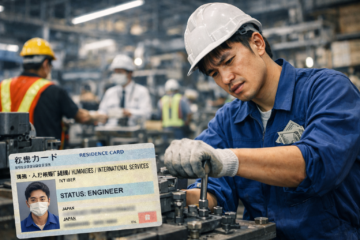
If you rely on labour supplied through dispatch arrangements, subcontracted logistics, cleaning, catering, or facilities management, the NAP’s direction suggests you should treat these as “core scope” for HRDD, not peripheral scope. The plan puts supply chain due diligence, disclosure expectations, and access to remedy into the same national policy package.
The revised NAP is also a signal to suppliers and SMEs. It explicitly places capacity building and support as a policy priority, which is often where due diligence efforts fail in practice.
Looking ahead to 2030
Japan’s revised NAP begins in fiscal year 2026 and the government plans to judge whether it needs revision within five years. That creates a natural runway to 2030 for delivery, evaluation, and potential escalation.
In that sense, the 2026–2030 NAP is not only a policy statement. It is a framework that links corporate behaviour, state incentives, and risk areas that are changing fast. For anyone working on responsible supply chains in Japan, it is now a central reference point, not background reading.



[9382]tkvip Official Login | সেরা অনলাইন স্লট গেম ও অ্যাপ ডাউনলোড,tkvip অ্যাপ ডাউনলোড করে সেরা অনলাইন স্লট গেম উপভোগ করুন। বিকাশ দিয়ে সহজ ডিপোজিট এবং খেলার নিয়ম জেনে আজই জয়েন করুন। visit: tkvip
I appreciate the variety of games available. There is always something new to explore and the rewards keep me coming back to vnke88
The app is super responsive and makes betting on the go so much easier. I love the clean layout of mostplaybetapp
If you love Jili slots, this is the spot. The jackpot feels reachable and the loading speed is impressive. Check abjilislot
Best gaming experience I have had in a while. The bonuses are generous and the site is very stable. Visit pky88888
[8405]Lodibet login link – legit na online slots gamit ang GCash,Gamitin ang lodibet login link para sa mabilis na access. Mag-download ng APK at alamin kung paano maglaro ng baccarat. Mag-register na at mag-enjoy! visit: lodibet
The app version is just way better than the browser. No lags at all and the VIP bonuses are actually generous. It makes the gaming experience so much more exciting. x888vipapk
Situs yang sangat terpercaya dan fair play. Saya sudah mencoba beberapa tempat tapi di sini yang paling nyaman dan winrate-nya oke. Langsung ke idarmorbet78
If you are looking for a fair and honest gaming site, phjilibett is the way to go. Five stars from me!
The login process is super quick and the games are top notch. Had a great run last night and won big. Highly recommend 178jililogin
Finally found a link that actually works without any glitches. The login process is seamless. Cheers to brazino777login for the great service.
The VIP treatment is real! The rewards and the exclusive games make the whole experience feel premium. Join the club at betbatvip
Great local experience and the payment methods are very flexible. It feels like they actually understand what players here want. Highly suggest pisokingph.
Found this site through a friend and it has been a blast so far. The game selection is top notch. Try ph62ph.
I love how straightforward everything is here. No hidden fees or confusing rules, just pure gaming fun. I’ll be spending a lot more time on pk97pk
I love how I can place my bets on the go. The app is stable and the odds are very competitive compared to others. 77888betapp is a winner.
The apk is very stable and the graphics are crisp. It’s much better than playing through a mobile browser. Five stars from me! e168apk
Really impressed with the game variety here. Everything loads fast and the support team is actually helpful. Give vnc186 a shot, you won’t regret it.
I’ve been looking for a reliable spot like this for a while. The interface is super smooth and everything loads fast. Definitely worth checking out! vnzxx88