
China’s new supply chain security regulation gives Beijing a sharper hand over cross-border business risk
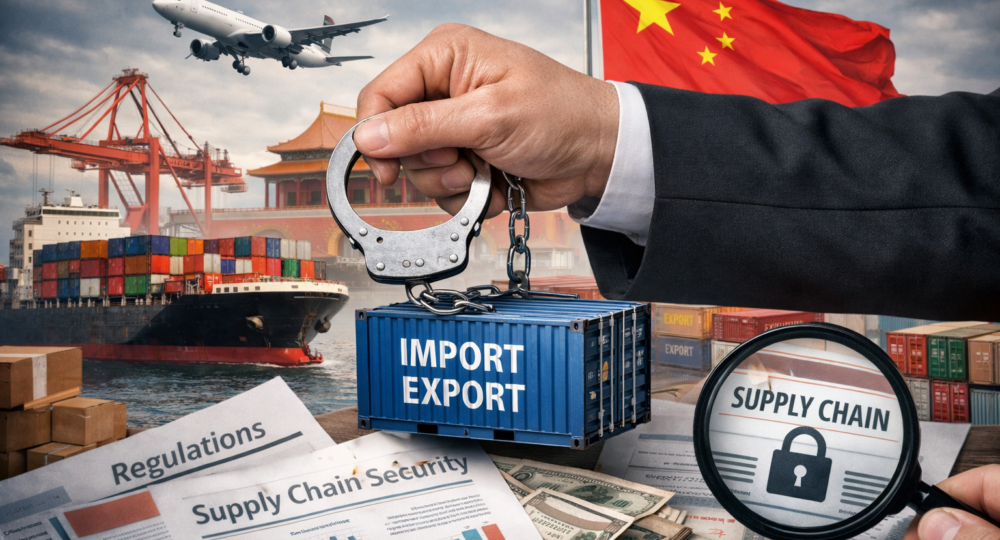
China’s new State Council regulation on industrial and supply chain security does more than promote resilience. It creates a broader legal basis for monitoring, intervention and countermeasures, with consequences for data, due diligence, commercial decisions and foreign-linked restrictions.
China has moved a sensitive policy area into a firmer legal frame. The State Council’s Regulations on the Security of Industrial and Supply Chains were adopted at a State Council executive meeting on 13 March 2026, signed by Premier Li Qiang on 31 March, published on 7 April, and took effect from the date of promulgation. The regulation contains 18 articles and is designed to prevent security risks in industrial and supply chains, strengthen resilience and security, and safeguard economic and social stability as well as national security.
At first glance, that may sound like another resilience measure. It is not. The regulation is more consequential than that. It places industrial and supply chain governance closer to the heart of China’s national security architecture, while also giving the authorities more explicit tools to investigate disruptions, organise emergency responses and respond to foreign measures that Beijing views as harmful to China’s supply chain security.
For companies, the key point is this: the regulation is not only about making supply chains stronger. It is also about making them more governable from the state’s perspective.
A resilience regulation with a national security core
The regulation makes clear from the outset that industrial and supply chain security is to be handled under the “overall national security concept”, while also balancing development and security, domestic and international considerations, and promoting high-level opening-up. It also states that China will support core technology research in key sectors and promote the stable and smooth functioning of global industrial and supply chains.
That combination is worth close attention. Beijing is not presenting this as a retreat from international supply chain integration. The text still speaks the language of openness and global stability. But it does so on terms that place security discipline, strategic sectors and state coordination at the centre. This reflects a broader shift in Chinese policymaking: supply chains are no longer treated mainly as channels of trade and production. They are now also treated as strategic assets, pressure points and possible legal battlegrounds.
That is why the regulation matters beyond China. It adds another layer to the operating environment for multinational firms, suppliers, service providers and industry platforms with China exposure.
The real story is not resilience alone, but state capacity
One reason this regulation stands out is the breadth of the state machinery behind it. The text assigns responsibilities across a long list of central authorities, including foreign affairs, development and reform, industry and information technology, public security, state security, finance, transport, agriculture and rural affairs, commerce, financial regulators, customs, market regulation and cyberspace authorities. Provincial-level governments are also brought into the framework under national coordination.
This is important because it suggests that implementation will not sit neatly in one ministry or one technical silo. A problem framed as “supply chain security” could involve trade controls, data questions, market conduct, emergency mobilisation, foreign relations or countersanctions logic at the same time. For business, that creates a wider compliance field and a higher chance that a commercial issue could be reclassified as a security issue.
In other words, the regulation builds state capacity across the chain, not only resilience within the chain.
“Key sectors” will decide where pressure lands first
The regulation says the relevant State Council departments will formulate and dynamically adjust a catalogue of key fields. In those areas, the authorities will strengthen support for the stable production, circulation and continued operation of raw materials, technology, equipment and products.
The absence of a published list in the regulation itself is not a small detail. It gives the authorities room to calibrate pressure over time and by sector. That makes the rule more flexible and, from a business standpoint, less predictable. Companies may know they are exposed to China, but they may not yet know whether they are exposed to a future “key field” designation or how that label could affect information expectations, risk monitoring or intervention.
This matters especially for sectors already close to strategic policy priorities, such as advanced manufacturing, critical inputs, transport links, digital infrastructure and technologies tied to industrial upgrading. The regulation does not name those sectors, but its structure makes clear that selective focus will be central to implementation.
Data and visibility are becoming part of supply chain security
Article 8 deserves far more attention than it has received. It calls for better information sharing in key sectors, stronger platform support and improved interconnection of industrial and supply chain information among industries and enterprises, while also requiring effective data security protection measures.
This is where the regulation becomes especially relevant for modern supply chain management. Many firms have spent recent years building greater visibility over suppliers, inputs, logistics routes and operational risks. In many markets, that has been treated as good governance. In China, under this new regulation, visibility is likely to be judged through a dual lens: useful for resilience, but also sensitive from a security and data-control angle.
That creates a difficult tension for multinationals. Group-level supply chain mapping, ESG reporting, customer traceability demands, audit systems and due diligence platforms all depend on gathering and moving information. Yet the Chinese policy direction points towards tighter expectations on how information in sensitive chains is shared, connected and protected. The issue is not only whether companies have enough data. It is whether they are handling the “wrong” kind of supply chain information in the “wrong” way or for the “wrong” external purpose.
That is a more complex problem than ordinary compliance teams are used to managing.
Due diligence and supply chain inquiries may face a harder edge
The most commercially delicate provision may be Article 13. It states that if any organisation or individual carries out investigations or other information-gathering activities in China concerning industrial or supply chains in violation of Chinese laws, administrative regulations, departmental rules or other state provisions, the relevant authorities may take corresponding measures.
This wording is broad, and the breadth is itself significant. The article does not define clearly where normal commercial inquiry ends and problematic information collection begins. That uncertainty could affect a wide range of business practices: supplier mapping, responsible sourcing reviews, human rights due diligence interviews, customer-driven verification exercises, benchmarking studies, factory audit preparation and certain compliance investigations.
The unique risk here is not that all due diligence becomes unlawful. The text does not say that. The risk is that the boundary becomes more contestable in politically or commercially sensitive situations. A process that looks routine from a global compliance perspective may look different if authorities see it as tied to foreign restrictions, discriminatory treatment, strategic-sector intelligence gathering or pressure on normal transactions.
That makes Article 13 more than a technical clause. It could become a friction point between global responsible business expectations and China’s expanding concept of supply chain security.
The regulation is also a response tool against foreign pressure
The regulation’s most striking feature is not domestic coordination. It is the creation of a more explicit legal mechanism to investigate and respond to foreign actions.
According to the official English summary, China will establish a security investigation mechanism under which relevant departments may launch investigations and take countermeasures against foreign countries, regions and international organisations, as well as foreign organisations or individuals, that undermine China’s industrial and supply chain security.
That summary is borne out in Articles 14 and 15. Article 14 covers situations where foreign states, regions or international organisations adopt discriminatory prohibitions, restrictions or similar measures in the industrial or supply chain field, or implement or assist conduct that harms China’s industrial and supply chain security. Article 15 reaches foreign organisations or individuals that, contrary to normal market transaction principles, interrupt normal transactions with Chinese citizens or organisations, take discriminatory measures, or engage in other conduct that causes or threatens substantial harm to China’s industrial and supply chain security.
This is where the regulation moves beyond resilience policy and into economic statecraft. It is not just a defensive framework for shortages or disruptions. It is also a basis for China to react where external controls, sanctions, market exits, supply suspensions or discriminatory treatment are seen as harmful to China’s interests.
For businesses, the operational problem is obvious. A company may face one set of legal pressures from its home jurisdiction or major export markets, and another set from China. The regulation increases the chance that decisions taken for sanctions compliance, export control compliance or reputational risk management abroad could attract attention in China if they affect Chinese parties or sensitive sectors.
Countermeasures may reach further than many firms expect
The available responses are extensive. Under Article 14, the relevant departments may impose or recommend measures such as prohibiting or restricting the import or export of goods and technologies, restricting international trade in services, and imposing special fees. The article also links to China’s Anti-Foreign Sanctions Law by providing for the possibility that organisations or individuals involved in making, deciding on or implementing those foreign discriminatory measures may be placed on a countermeasure list. Under Article 15, measures may include restrictions on import and export activities involving China, investment in China, transactions or cooperation with Chinese parties, and entry, work, stay or residence in China.
This is not merely symbolic language. It means the potential consequences can move from policy signalling into real commercial restriction. It also means a firm’s China risk can no longer be assessed only by looking at its own China operations. Risk may also arise from the conduct of group entities, affiliates, upstream commercial decisions or compliance steps taken elsewhere.
That extraterritorial flavour is one of the regulation’s most important features.
The hidden pressure point is on companies inside China
Article 16 is perhaps the most practical article for foreign-invested businesses and China-based operations. It requires organisations and individuals in China to implement measures taken under Articles 14 and 15. If they do not, authorities may order rectification and can restrict or prohibit activities in areas such as government procurement, bidding and tendering, import and export of goods and technology, international trade in services, and cross-border provision or receipt of data and personal information. They may also take measures related to exit from or stay in China.
This point deserves more attention than the headlines about countermeasures. The regulation does not only create tools against foreign actors. It also creates compliance expectations for persons and entities within China. That means local subsidiaries, joint ventures, branch offices, local management and service teams may face pressure to act in line with Chinese countermeasures even where a parent company is under contrary expectations elsewhere.
That is the unique governance challenge this regulation creates. It sharpens the risk of internal conflict within multinational groups. The China entity may not be able to treat these issues as abstract geopolitical noise. It may have direct legal obligations under Chinese law.
What makes this regulation different from previous policy signals
China has spoken for years about supply chain security, resilience and stable industrial chains. What is new here is the legal consolidation. The Ministry of Justice has described the regulation as a “new legal tool” for safeguarding industrial and supply chain security and part of a broader effort to enrich China’s external-related security legislation.
That matters because companies often learn to live with broad policy language. A formal State Council regulation is different. It gives agencies a clearer legal frame, a procedural anchor and stronger grounds to coordinate action. It also sends a message to local authorities, industry bodies and companies that supply chain security is no longer a loose policy slogan. It is now a defined administrative field with enforceable consequences.
What companies should watch next
The next stage will matter as much as the text itself. The regulation leaves room for further definition, especially around key sectors, monitoring mechanisms, investigative practice and the treatment of information-gathering activities. Much will depend on follow-up guidance, administrative practice and how authorities apply these provisions in real cases.
For now, companies should resist two mistakes. One is complacency. The other is overreaction. The regulation does not mean normal cross-border business in China has suddenly become impossible. But it does mean that supply chain governance, due diligence, data handling and commercial decisions involving Chinese parties now sit closer to national security logic than before.
That changes the tone of the operating environment. It also changes the questions that boards, legal teams and supply chain leaders should ask.
For companies with material China exposure, the more useful question is no longer simply whether their supply chain is resilient. It is whether their resilience strategy is legally and politically workable in a world where supply chains are increasingly governed as instruments of state security.
This article is also available in:


24 comments
Leave a reply





[8243]turbo6 Official Login | Trusted Online Slots Malaysia Fast Payout,turbo6 provides a secure platform for online slots in Malaysia. Access the official login or get the apk download for a seamless gaming experience. Join today! visit: turbo6
[6402]bn88 Official Login | সেরা অনলাইন ক্যাসিনো বোনাস ও স্লট গেম,bn88 অ্যাপ ডাউনলোড করে সেরা স্লট গেমের অভিজ্ঞতা নিন। বিকাশ দিয়ে টাকা জমা করে আকর্ষণীয় বোনাস উপভোগ করুন। আজই জয়েন করুন। visit: bn88
[3993]333ok Official Login | সেরা অনলাইন ক্যাসিনো বোনাস ও অ্যাপ,333ok-এ দ্রুত টাকা তোলার সুবিধা এবং আকর্ষণীয় অনলাইন ক্যাসিনো বোনাস উপভোগ করুন। আজই অ্যাপ ডাউনলোড করে স্লট গেমের নিয়ম জানুন ও খেলা শুরু করুন। visit: 333ok
I have tried plenty of sites over the years but this one stands out for how well it caters to our community. The dashboard is clean and intuitive which makes it easy to jump straight into the action without any confusion. Deposits and withdrawals through our local banks are processed lightning fast and the support team speaks our language perfectly. A trustworthy choice for relaxed gaming sessions. vnkm938
I have been testing various online casinos for months and this one finally checks all the boxes for me. The registration takes less than a minute and I got straight into my favorite slots. Payment methods are flexible and I feel completely safe managing my bankroll here. pkcasibom
I switched over from another provider and have not looked back since. The sports section complements the casino games perfectly and I can manage both in one place. Withdrawals hit my e wallet within minutes and the verification process is hassle free. A genuinely reliable spot for entertainment. thseabet333
The app installation was a breeze and it runs perfectly on my phone without any lag. Thanks for the easy access via okplayappdownloadapk.
I’ve been using this app for a week now and the interface is just so clean. Everything loads fast and the payouts are legit. Highly recommend phsuperlgapp for anyone looking for a stable experience.
Honestly the best gaming experience I’ve had in a while. The bonuses are generous and the customer support is top notch. Highly recommend vnnohu77 to everyone.
Very stable connection and the registration was a breeze. I appreciate how they keep things simple and efficient. Big thumbs up for jili178login.
If you love slots then this is the place to be. The variety is insane and the loading times are very short. Big shoutout to 50jilislot for the awesome vibes.
[8739]cv999 Login Rasmi | Slot Online Trusted Malaysia Cuci Pantas,cv999 menyediakan akses login rasmi untuk slot online trusted Malaysia. Download apk sekarang dan nikmati game slot cuci pantas. Daftar akaun anda hari ini! visit: cv999
I have been using this platform for a while now and the payouts are consistently fast. Definitely one of the most reliable sites I have encountered. Check out idrpvip5 if you want a premium feel.
Clean design and very easy to navigate. I didn’t have to struggle at all to find my favorite games. Great job by vnopen8.
Great experience overall. The rewards system is very generous and the community is active. See you all at juragan88login!
[4475]tk10 লগইন ও অ্যাপ ডাউনলোড | বিকাশ দিয়ে অনলাইন স্লট গেম,tk10 লগইন করুন এবং সেরা অনলাইন স্লট গেম উপভোগ করুন। বিকাশ দিয়ে অনলাইন ক্যাসিনো ডিপোজিট ও অ্যাপ ডাউনলোড করে আজই খেলা শুরু করুন। visit: tk10
[3963]f168 | Link vào tải app và hướng dẫn chơi baccarat online,Truy cập f168 để nhận link vào mới nhất, tải app tiện lợi và học mẹo quay hũ nổ hũ dễ thắng. Hỗ trợ nạp tiền casino qua Momo nhanh chóng. Tham gia ngay! visit: f168
A solid choice for anyone who loves the casino atmosphere online. The live dealers are professional and the atmosphere is exciting. Join phbetpkcasino today.
This is probably the most user friendly portal I’ve used this year. Everything is just where it should be. Glad I found 289betlogin.
I really appreciate the bonuses they offer for new players. It gives a great head start. Definitely check out grenbet if you enjoy betting.
Finally found a platform that does not lag during peak hours. The login process is seamless and I got my bonus right away. Great vibes all around at ck777betlogin
Finally found a platform that actually pays out on time. The registration process was a breeze and I was playing within minutes. kr86kr
I really enjoy the variety of slots available here. The jackpots feel reachable and the vibe is just right. Big shoutout to ph16jili!
Solid platform with a great selection of games. The registration was a breeze and I started playing in minutes. Check betmgmcasino