Want a seat at UNRBHR Forum 2026? Then start with what the organisers are really looking for
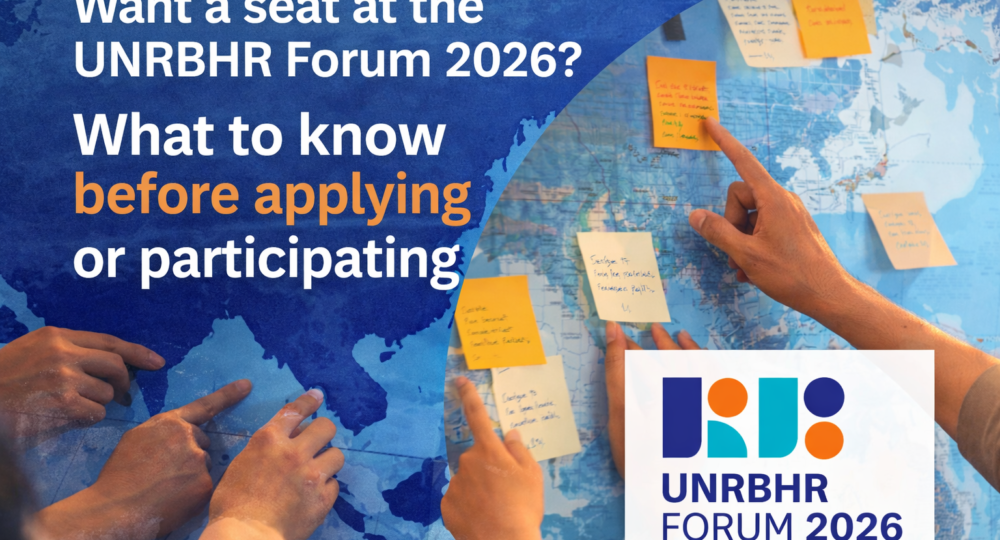
The race to shape the United Nations Responsible Business and Human Rights Forum in Asia-Pacific has already begun. For many organisations, the real work this year will start well before Bangkok. It will begin with the bid for a session, the search for co-organisers, and the challenge of writing a concept note that does not read like every other proposal in the pile.
According to sources tracked by the Asia Pacific Responsible Supply Chain Desk, this year’s Forum is not just another convening for broad statements on responsible business. It is being framed as a more practical, more interactive, and more solution-oriented space, with stronger emphasis on regional realities, rights-holder participation, and collaboration across sectors. That changes what potential co-organisers, speakers and attendees should look out for.
For organisations hoping to get into the programme, the key question is no longer only whether their topic is important. The more important question is whether they can pitch it in a way that fits what the Forum appears to want this year.
This is not the year for a generic panel
One clear message from the Forum’s recent framing is that organisers want sessions that are inclusive, interactive, grounded in regional realities, and built around practical collaboration. The consultation process also aimed to gather views on agenda design, solution-oriented dialogue, and opportunities for collaboration. That is a strong signal that proposals built around vague awareness-raising or recycled talking points may struggle to stand out.
This matters because many organisations will approach the Forum in a familiar way. They will start with a topic they care about, gather a few friendly names, and build a panel around broad discussion. That approach may no longer be enough.
A stronger concept note will need to show exactly why the issue matters now, why the discussion belongs in Asia-Pacific, what the audience will leave with, and why the chosen format is the right one. In other words, the bid needs to read less like a conference placeholder and more like a session with a reason to exist.
The smartest co-organisers will not just chase logos
The Forum’s own materials make clear that groups submitting proposals may be asked to collaborate. That means organisations should think carefully about co-organisers from the start, not treat them as decoration added at the end.
This is where many bids can go wrong. A long list of logos may look impressive, but it does not always create a stronger session. What matters more is whether the mix of co-organisers helps answer three questions.
The first is whether the session brings real diversity of perspective. A proposal led by several organisations that all say roughly the same thing may look safe, but it will not necessarily look balanced. The second is whether the partnership reflects the Forum’s multi-stakeholder ambition. The business and human rights field now expects more than a closed circle of international organisations talking to one another. The third is whether the co-organisers can actually deliver. A concept note is easier to approve than a weakly coordinated session with confused moderation, overlapping speakers and no common message.
For that reason, the most credible bids are likely to be those that combine complementary strengths. One partner may bring convening power, another operational case studies, another policy depth, and another direct connection to rights-holders or local realities. That is more convincing than a coalition built only on reputation.
The concept note needs to solve a problem, not just name one
The Forum’s 2025 concept framing offers a useful clue for 2026. It highlights policy coherence, markets and supply chains, inclusion and protection, and sustainability transitions as the key tracks. It also stresses that the event should generate practical tools, models, recommendations and follow-up value beyond the meeting itself.
That should shape how organisations write their concept notes this year.
A weak proposal says there is an urgent issue and that stakeholders should discuss it. A stronger proposal shows what specific problem the session will tackle, why current approaches are not enough, and what kind of progress the discussion could unlock. That could be a clearer understanding of implementation barriers, a set of practical recommendations, a more honest exchange between buyers and suppliers, or a case-based discussion that helps others avoid common mistakes.
For organisations in the supply chain space, this is particularly important. There will likely be many proposals on due diligence, forced labour, remedy, climate risk, migrant workers, ESG, digital governance and just transition. Those themes are all relevant. But relevance alone will not make a proposal memorable. The sharper bids will be the ones that define the tension beneath the topic.
A proposal on due diligence, for instance, should not stop at “companies face pressure to comply”. It should ask which pressure matters, where implementation breaks down, who bears the cost, and what kind of practical response is missing in the region.
Rights-holder participation is likely to carry more weight
The official framing puts unusual emphasis on rights-holder leadership and inclusive participation, including workers, migrants, Indigenous Peoples, environmental defenders, youth, women and persons with disabilities. That is not a passing phrase. It appears as a core design principle of the Forum.
Potential co-organisers should pay close attention to that.
Too many session proposals still treat affected groups as people to be discussed rather than people who shape the discussion. That weakens both the substance and the credibility of a session. If a concept note claims to deal with remedy, labour exploitation, recruitment abuse, digital harm or environmental displacement, but includes no meaningful rights-holder perspective, the gap will be obvious.
This does not mean every panel needs the same formula. It does mean organisers should think more carefully about who has standing to speak, what kind of participation is meaningful, and whether the session design gives space to experience, disagreement and concrete realities rather than polished institutional lines.
Regional grounding will matter more than imported language
Another thing to watch is the Forum’s insistence on regional and local realities. The consultation materials refer to geopolitical tension, fragmented regulation, climate pressure, inequality, digital disruption and shrinking civic space across Asia-Pacific. The concept note also frames the Forum as a space for regionally grounded approaches that respond to rights-holder expectations and regulatory change.
That should be a warning to anyone preparing a proposal that could be delivered in exactly the same form in Geneva, Brussels or New York.
For Asia-Pacific-focused organisations, this creates an opening. Sessions that bring real regional texture are likely to land better. That could mean comparing how different Asian jurisdictions are approaching due diligence, showing how supplier realities differ across markets, or looking at how business and human rights questions are being reshaped by Asian industrial policy, trade dynamics, labour migration and political constraints.
The Asia Pacific Responsible Supply Chain Desk has covered many of these shifts already. The region’s business and human rights debate is now bound up with supply chain security, trade fragmentation, climate transition, state regulation, and the uneven spread of due diligence and forced labour measures. A concept note that captures those links is more likely to feel timely than one built only around global language.
Attendees should look for sessions that offer more than advocacy theatre
The same logic applies to participants deciding whether the Forum is worth their time.
For businesses, the useful sessions will not be the ones that simply restate familiar principles. They will be the ones that deal honestly with implementation trade-offs, buyer-supplier tensions, evidence demands, remedy failures and regulatory friction. For civil society, the stronger sessions will likely be those that create real space for accountability and lived experience rather than symbolic participation. For governments and regulators, the more valuable discussions will be those that address policy coherence and practical enforcement rather than policy ambition in the abstract.
Attendees should therefore be selective. The best test is simple. Does the session appear designed to produce something useful, or just to display alignment among the organisers? If it is the latter, the room may be full, but the value may be thin.
What a strong bid is likely to look like this year
For organisations considering a proposal, a few features are likely to separate stronger bids from weaker ones.
A stronger bid will have a narrow enough focus to feel purposeful, but wide enough relevance to draw a mixed audience. It will show why the issue matters in Asia-Pacific now. It will build the session around a tension, gap or practical challenge rather than a broad theme. It will choose co-organisers who add something real. It will reflect the Forum’s preference for inclusion, practical exchange and follow-up value. And it will be honest about what the session can actually achieve in the time available.
Just as importantly, it will show some discipline. One of the risks at large forums is topic inflation. Every concept note tries to cover too much. The result is often a crowded panel that leaves no room for sharp questions or clear takeaways. A bid that knows what it is not trying to do can sometimes look stronger than one that promises everything.
Bangkok will start on paper
The Forum itself may take place in September, but for many organisations the real contest is already under way. It is happening in draft concept notes, in outreach to possible partners, in decisions about whether to pursue a spotlight, a panel or a workshop, and in choices about what kind of session is actually worth fighting for.
That is why the most important thing to watch right now is not only the Forum theme. It is the organiser logic behind it.
According to the direction signalled so far, the organisations most likely to gain traction are not simply those with the loudest issue or the biggest name. They are the ones that understand where the Forum is trying to go: fewer empty discussions, more practical exchange, stronger regional grounding, better stakeholder balance, and sessions that leave people with something more useful than a polite summary.
For anyone hoping to co-organise, speak or attend, that is the real point to keep in mind. Bangkok will start on paper. The concept note is where the first judgement will be made.
This article is also available in:
18 comments
Leave a reply





[113895]supplies professional anti-violence equipments and solutions for the whole world with strong and perfect production capacity. anti-violence.org
[9399]555rr Official Login | অনলাইনে ক্যাসিনো গেম ও দ্রুত বিকাশ পেমেন্ট,555rr-এ আজই লগইন করে সেরা স্লট গেম নিয়ম জানুন এবং অ্যাপটি ডাউনলোড করে নিন। দ্রুত বিকাশ পেমেন্টের মাধ্যমে সহজ লেনদেনের অভিজ্ঞতা নিন। এখনই যোগ দিন। visit: 555rr
[296]cbaji Official Login | বিকাশ পেমেন্ট ও সেরা অনলাইন ক্যাসিনো বোনাস,cbaji অ্যাপ ডাউনলোড করে সেরা স্লট গেমের নিয়ম জানুন এবং বিকাশ দিয়ে সহজে গেম খেলুন। আকর্ষণীয় বোনাস পেতে আজই জয়েন করুন। visit: cbaji
[4406]bd777 Official Login | সেরা অনলাইন ক্যাসিনো ও অ্যাপ ডাউনলোড,bd777-এ যোগ দিয়ে সেরা অনলাইন ক্যাসিনো গেমসের অভিজ্ঞতা নিন। বিকাশ দিয়ে টাকা জমা এবং অ্যাপ ডাউনলোডের সহজ উপায় জানুন। আজই আপনার অ্যাকাউন্ট খুলুন। visit: bd777
[395813]supplies professional anti-violence equipments and solutions for the whole world with strong and perfect production capacity. anti-violence.org
[739]okbet15 Official Login | Best GCash Online Casino Philippines,okbet15 offers a secure gaming experience. Download the app for easy access to top online slot sites in the Philippines. Join now and start playing today. visit: okbet15
The bonuses here are legit and the registration process took me less than two minutes. Really impressed with the speed. iny7777
The app is incredibly smooth and the graphics are stunning. It makes the betting experience so much more immersive. Love 3366betapp.
Super easy to navigate and the game selection is huge. It is my new favorite go to spot for some weekend fun. Love jljl333login.
Quick access and no hassle with the account setup. It’s rare to find such a user-friendly site these days. Glad I found yy567login.
The login process here is lightning fast. I hate waiting for pages to load, but this site is snappy and efficient. Definitely the best way to access ww777login.
Getting into my account is always seamless. No annoying errors or long wait times. The access via dino69login is the smoothest way to get back into the action.
[9800]Bangla ক্যাসিনো লগইন এবং বিকাশ ডিপোজিট স্লট গেম,bangla ক্যাসিনো অ্যাপ download করে লাইভ ডিলার ক্যাসিনো গেম খেলুন। বিকাশ দিয়ে ক্যাসিনো ডিপোজিট করে আজই আপনার অ্যাকাউন্ট লগইন করুন। visit: bangla
[4843]ee99 | Link vào chính thức và cách chơi baccarat online,Truy cập ee99 để trải nghiệm game nổ hũ đổi thưởng hấp dẫn. Hướng dẫn tải app ee99 nhanh chóng và nạp tiền qua Momo casino tiện lợi. Tham gia ngay hôm nay! visit: ee99
The VIP treatment here is the real deal. The exclusive offers are great and the overall experience is very premium. I am staying with 50jilivip
The login process is seamless and I never encounter any glitches. Everything just works perfectly on 24jiliparklogin.
I’ve tried a few sites lately but this one really stands out. The payout speed is impressive and the games are super smooth. Highly recommend phrubycasino to everyone looking for a reliable spot.
Looking for an apk? Gave win555apk a go. Installation was a breeze and it has some interesting features. Take a look here: win555apk