
Nepal’s LDC graduation is a supply chain deadline, not a development headline
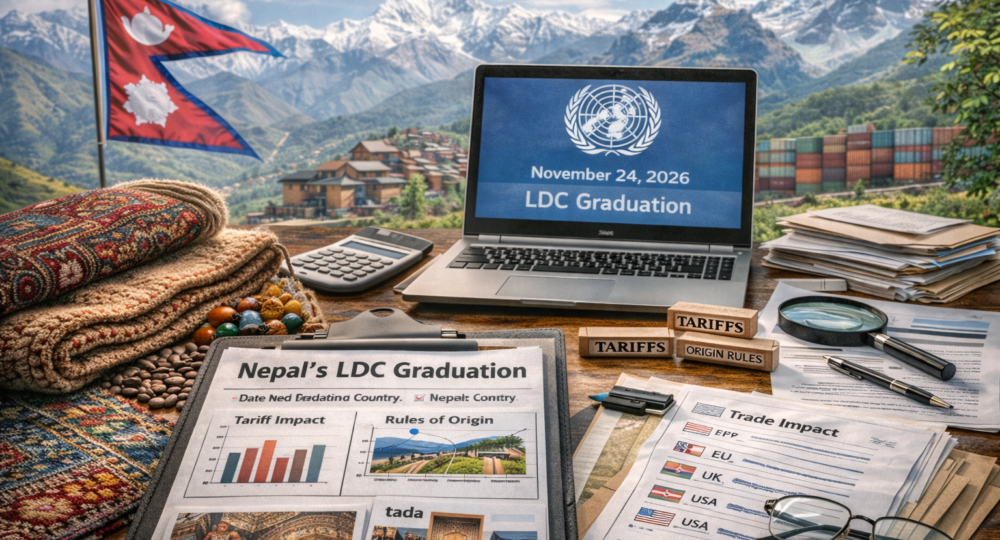
On 24 November 2026, Nepal is scheduled to graduate from the Least Developed Country category under United Nations processes.
That date matters to exporters for a simple reason. LDC status is not only a label. It is a bundle of market access conditions, rules, and cost advantages that sit quietly inside contracts, pricing, and production plans. When those conditions change, supply chains feel it first.
Why 24 November 2026 changes the commercial maths
For many buyers, Nepal is a “small volume, high story value” sourcing destination: hand-knotted carpets, pashmina, niche garments, artisan goods, and some higher-end home textiles. Volumes can be modest, but price sensitivity is real. A tariff shift of a few percentage points can decide whether an order stays, moves, or gets redesigned.
The graduation itself is not the cliff edge. The cliff edge is what happens after the transition periods in key importing markets run out, and tariffs and origin rules reset to less generous terms.
The EU market is the biggest immediate watchpoint
For exports into European Union markets, Nepal currently benefits from duty-free, quota-free access for almost all goods under Everything But Arms while it remains an LDC. EU messaging to Nepal has been blunt that this access does not continue indefinitely after graduation, and it highlights a three-year transition period after graduation.
That creates a very practical window.
If Nepal graduates on 24 November 2026, then the “preference runway” many exporters rely on effectively ends around late 2029, unless a new preferential arrangement is secured and used properly. This is not abstract policy. It is a pricing deadline that will land mid-contract cycle for some long-lead products.
There is also a second-order effect. When a buyer expects preference erosion, they often compress risk by shortening commitments. They may shift from longer-term programmes to trial orders, or they may request re-costing clauses that trigger when tariffs change. Even before tariffs rise, the uncertainty can reshape sourcing behaviour.
The UK is a different story, but still a change to plan for
The UK Developing Countries Trading Scheme is designed to offer a smoother path for countries graduating from LDC status. A UK Parliament briefing notes that, after an LDC graduates, it moves to the “Enhanced Preferences” tier after a three-year transition period.
This matters because it means the tariff shock may be smaller than under older preference systems, but it does not mean “no change”. Enhanced Preferences still come with their own rules of origin and administrative expectations. If documentation discipline is weak, preference can be lost even when it exists.
It is not only tariffs. It is also rules of origin risk
Preference erosion is often explained as “tariffs go up”. In real supply chains, rules of origin can be equally decisive.
When margins are tight, buyers will ask a hard question: can Nepal keep meeting origin rules without increasing cost or changing materials? This is most acute for garments and home textiles, where inputs can be heavily imported and where processing steps determine origin status.
If origin rules become harder to meet, a product can face tariffs even if it “should” be eligible for a preference scheme. That is a supply chain execution problem, not a trade lawyer’s problem.
Nepal’s exporters will feel pressure in three ways
First, price competitiveness will take a hit in segments where buyers have many substitutes, especially basic apparel and commoditised home textiles.
Second, compliance and documentation costs will rise because buyers will demand cleaner origin evidence, clearer costing logic, and stronger traceability of inputs. This is where smaller suppliers often struggle. The paperwork burden does not scale down neatly.
Third, buyer concentration risk can rise. When a country loses a pricing advantage, some buyers leave. The buyers who remain often have more leverage. They may push for longer credit terms, tighter delivery windows, and stronger audit rights.
How big could the trade impact be?
The International Trade Centre has flagged that Nepal could lose a measurable share of exports due to tariff changes after graduation, and it frames preference loss as a direct commercial risk rather than a symbolic one.
The exact outcome will vary by product and market, but the direction is clear: without an active transition plan, some export lines will struggle to hold market share on price alone.
A supply chain playbook for the 2026–2029 runway
This is the period when buyers and suppliers can still make changes without panic.
Start with preference exposure mapping. Firms should identify which product lines rely on LDC preferences, which destination markets matter most, and what the “tariff-at-risk” number is in plain cash terms. This should be done SKU by SKU, not as a country-level estimate.
Then lock down origin discipline. If a product only qualifies for preferences under specific processing steps, then that process must be consistent, documented, and auditable. Small deviations in sourcing or subcontracting can quietly break eligibility.
Next, shift the product mix where possible. Nepal is strongest where craftsmanship, design, and authenticity matter more than pure cost. Buyers will accept some price premium when the product has fewer credible substitutes. This is harder work than chasing volume, but it protects revenue when tariffs rise.
Finally, use the transition window to improve contracting. Buyers and suppliers can agree in advance how tariff changes are handled, how re-costing works, and how orders are prioritised when demand softens. If this is not set early, it becomes a fight later.
What to watch between now and November 2026
Watch whether the EU pathway shifts from EBA to another preference route for Nepal, and whether firms can realistically meet the conditions and administration requirements that come with it. The EU has pointed to GSP+ as a possible route, but that requires policy and compliance steps beyond trade paperwork.
Watch how Nepal’s own smooth transition strategy is implemented, especially measures that help exporters with standards, testing, accreditation, and trade facilitation. Workshops and planning documents exist, but exporters benefit only when processes and costs improve at the border and in certification.
The core message
Nepal’s LDC graduation on 24 November 2026 is a fixed date.
For supply chains, the real deadline is the end of the preference transition periods that follow, because that is when pricing and sourcing decisions will reset.
The winners will be the exporters and buyers who treat 2026–2029 as a redesign window, not a waiting room.



29 comments
Leave a reply





[8446]zbazz Official Login | সেরা অনলাইন ক্যাসিনো বোনাস ও অ্যাপ ডাউনলোড,zbazz এর মাধ্যমে সেরা অনলাইন স্লট গেমের নিয়ম জানুন এবং দ্রুত বিকাশ পেমেন্ট সুবিধা উপভোগ করুন। আজই অ্যাপ ডাউনলোড করে খেলা শুরু করুন। visit: zbazz
[2487]Samosir88 | Login Resmi Situs Slot Gacor Terpercaya Deposit Pulsa,Samosir88 menyediakan akses login resmi untuk menikmati judi casino deposit pulsa dan panduan cara main baccarat online. Download apk sekarang dan mulai bermain. visit: samosir88
[3649]ckk44 Official Login | বিকাশ ডিপোজিট ও সেরা লাইভ ক্যাসিনো বোনাস,ckk44 অ্যাপ ডাউনলোড করে উপভোগ করুন সেরা অনলাইন স্লট গেম। বিকাশ দিয়ে সহজ ডিপোজিট এবং আকর্ষণীয় বোনাস পেতে আজই জয়েন করুন। visit: ckk44
[2053]qqgg Official Login | সেরা অনলাইন ক্যাসিনো ও দ্রুত বিকাশ পেমেন্ট,qqgg অ্যাপ ডাউনলোড করে সেরা অনলাইন ক্যাসিনো গেমস উপভোগ করুন। এখানে দ্রুত বিকাশ পেমেন্ট এবং স্লট গেম খেলার সহজ নিয়ম পাবেন। আজই জয়েন করুন। visit: qqgg
[9233]Kirkiriya Official Login | বিকাশ পেমেন্ট ও অনলাইন ক্যাসিনো বোনাস,kirkiriya অ্যাপ ডাউনলোড করে সেরা অনলাইন ক্যাসিনো বোনাস উপভোগ করুন। বিকাশ দিয়ে টাকা জমা এবং স্লট গেম খেলার সহজ নিয়ম জানতে আজই যোগ দিন। visit: kirkiriya
[4277]joker11: Login Resmi & Slot Gacor Deposit Pulsa Tanpa Potongan,joker11 menyediakan akses login resmi dan download apk terbaru. Nikmati slot gacor hari ini dengan deposit pulsa tanpa potongan. Daftar dan mainkan sekarang juga! visit: joker11
[5136]ck777 Official Login | বিকাশ ডিপোজিট ও সেরা ক্যাসিনো বোনাস,ck777 অ্যাপ ডাউনলোড করে সেরা অনলাইন ক্যাসিনো বোনাস লুফে নিন। বিকাশ দিয়ে সহজেই ডিপোজিট করুন এবং স্লট গেমের নিয়ম বুঝে আজই খেলা শুরু করুন। visit: ck777
Really impressed with the odds and the overall vibe of the site. It feels very secure and fair for the players. Give br79bet42 a try if you are looking for something fresh.
Really impressed with the customer support and the overall vibe of the site. It is a very welcoming place for both new and old players. khala88login is definitely a winner.
Really impressed with the game variety here. It is my go-to spot for relaxing and winning some extra cash. Visit idjuragan88 now.
The excitement here is on another level. Great selection of games and the mobile version works like a charm. Check out pkbetmgm now.
The graphics are top notch and the gameplay is very immersive. It feels like a premium casino experience from home. Love zx999game.
[5354]930k লগইন এবং অ্যাপ ডাউনলোড – বিকাশ অনলাইন ক্যাসিনো ও স্লট গেম,930k login করুন এবং অ্যাপ ডাউনলোড করে সেরা স্লট গেম সাইট উপভোগ করুন। বিকাশ দিয়ে অনলাইন ক্যাসিনো খেলা এখন আরও সহজ, আজই জয়েন করুন। visit: 930k
The login process is super quick and everything just works. I appreciate how straightforward the layout is. Give 22funlogin a try!
[5574]melbet ডাউনলোড ও লগইন – বিকাশ দিয়ে অনলাইন স্লট গেম খেলুন,melbet ডাউনলোড করে সহজেই লগইন করুন। বিকাশ দিয়ে অনলাইন ক্যাসিনো এবং আসল স্লট গেম সাইট উপভোগ করতে আজই অ্যাপটি ইনস্টল করুন। visit: melbet ডাউনলোড
No more hassle with account access! The login page is stable and works perfectly on my mobile. Cheers to 8jilibetlogin.
Really impressed with the variety of slots here. I managed to hit a nice win yesterday and the withdrawal was seamless. Love br55wwbet.
As someone who spends most of my free time hunting for the best slot games I can honestly say this platform delivers every single time. The volatility options are perfectly balanced and I actually enjoy the sound effects and animations without them feeling cheap. Plus the daily promotions keep the excitement alive long after my first win. idistanaslot
Love the variety of slots available here. There is always something new to try and the login is always stable and fast. sinislotslotlogin
Really loving the game variety here. It keeps things exciting and the graphics are top notch. Definitely spending my weekends on phsmjili.
Finally found a site that actually pays out consistently. The customer support team is also very helpful when I had issues with my account. Highly recommend idstudiobet78.
I’ve been looking for a reliable platform for a while and this one really delivers. The interface is smooth and the payouts are fast. Definitely check out asia128login for a great experience.
I love the layout and the overall vibe of this site. It feels professional and trustworthy. I am spending a lot of my free time on idasia128 lately.
Really impressed with the interface here. Everything loads fast and the payouts are smooth. Definitely my new favorite spot! Check out pkcvpro91
[9728]Gila138: Login Daftar Akun Slot Deposit Dana Tanpa Potongan,Gila138 menyediakan akses login cepat dan daftar akun mudah. Nikmati slot deposit dana tanpa potongan serta download apk casino android sekarang juga. visit: gila138
Really great way to earn extra on the side while having fun. The system is transparent and honest. Join earnphplogin now.
PK999gamedownload? Worth a shot! I’m always looking for new games to try out. Fingers crossed it’s got some good ones. pk999gamedownload
The game variety on this site is top notch. I really enjoy the interface and how smooth everything runs on my mobile phone. Highly recommend ph291jili
Fast withdrawals and great customer support. It is rare to find a platform this reliable these days. Trust pkji8888 for your gaming.